
Agricultural Robotics
Robots in Agriculture — Precision, Automation & AI
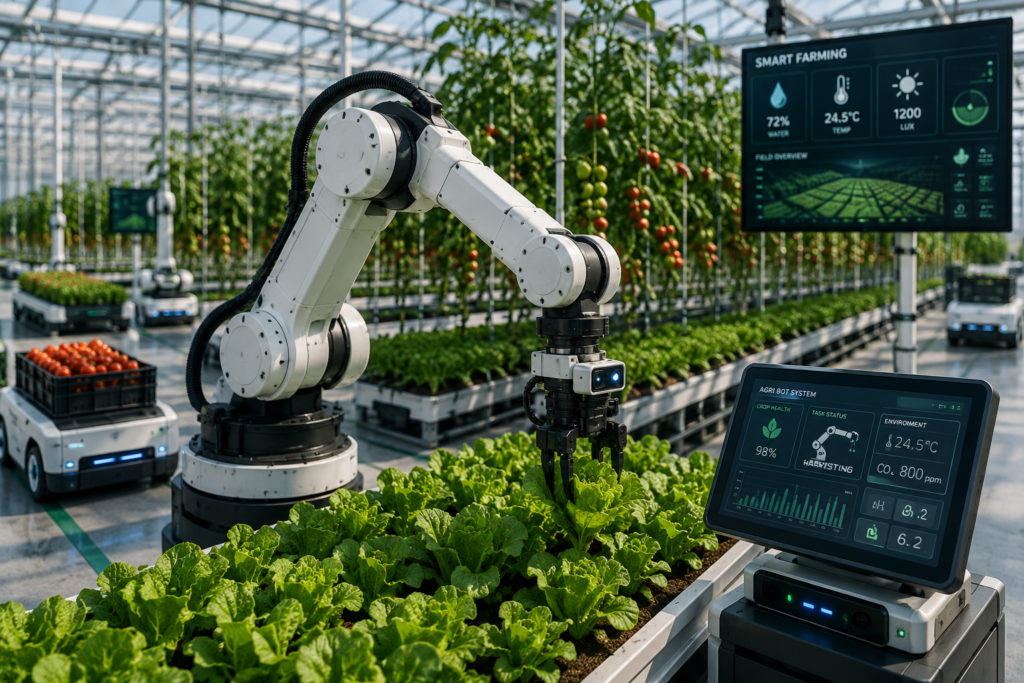
What if robots could help grow and harvest food with extraordinary precision?
Agricultural robots are transforming farming, greenhouse production and crop management.
Robotic systems can monitor plants, identify crops with computer vision, harvest produce and perform repetitive tasks with high precision.
Automation allows robots to work continuously while sensors and AI provide real-time information about plants and their environment.
Teleoperation adds another possibility: a human operator could remotely control a robot when a task requires judgement or manual intervention.
Agricultural robotics requires three essential abilities:
PRECISION + PERCEPTION + DECISION MAKING
Learning these skills is the foundation for controlling increasingly intelligent agricultural robots.
Could you control a robot to harvest a crop without damaging it?
PRACTICAL MICRO-LESSON 01
FRUIT HARVESTING DECISION
MISSION 01 — SELECT THE SAFE HARVEST ACTION
A harvesting robot detects a ripe tomato ready to be picked.
The vision system estimates that the tomato can tolerate a maximum gripping force of 4 N without damage.
The robot can choose between three gripping forces.
Which action should the robot perform?
PRACTICAL MICRO-LESSON 02
RIPENESS & VISION DECISION
MISSION 02 — IDENTIFY THE CORRECT CROP
A harvesting robot uses its vision system to inspect three tomatoes.
Tomato A: 40% ripe
Tomato B: 92% ripe
Tomato C: 65% ripeThe harvesting rule requires a ripeness level of at least 85%.
The robot must harvest only crops that meet the required ripeness level.
Which tomato should the robot harvest?
PRACTICAL MICRO-LESSON 03
PRECISION PICKING POSITION
MISSION 03 — CHOOSE THE SAFE APPROACH
A harvesting robot has identified a ripe tomato.
The tomato is surrounded by leaves and branches.
The vision system detects three possible approach paths to the fruit.
Path A: shortest path, but passes through a branch.
Path B: clear path with 20 mm safety clearance.
Path C: clear path with only 3 mm safety clearance.The robot must reach the tomato without touching the surrounding plant.
Which approach path should the robot choose?
PRACTICAL MICRO-LESSON 04
DYNAMIC OBSTACLE RESPONSE
MISSION 04 — RESPOND TO A CHANGING ENVIRONMENT
The robot is moving toward a ripe tomato selected for harvesting.
During the approach, a leaf moves into the robot’s planned path.
The vision system detects the new obstacle before contact occurs.
Continuing on the current trajectory could damage the plant.
What should the robot do first?
PRACTICAL MICRO-LESSON 05
COMPLETE HARVEST DECISION
MISSION 05 — COMPLETE THE HARVEST CYCLE
A harvesting robot is preparing to pick a tomato.
The vision system confirms that the tomato is 92% ripe and approved for harvesting.
The tomato can tolerate a maximum gripping force of 4 N.
During the approach, the robot detects a branch blocking its normal path.
The robot must harvest the tomato without damaging the fruit or the plant.
Which sequence of actions is correct?