
AI & Autonomous Robotics
Intelligent Robots — Perception, Autonomy & Physical AI
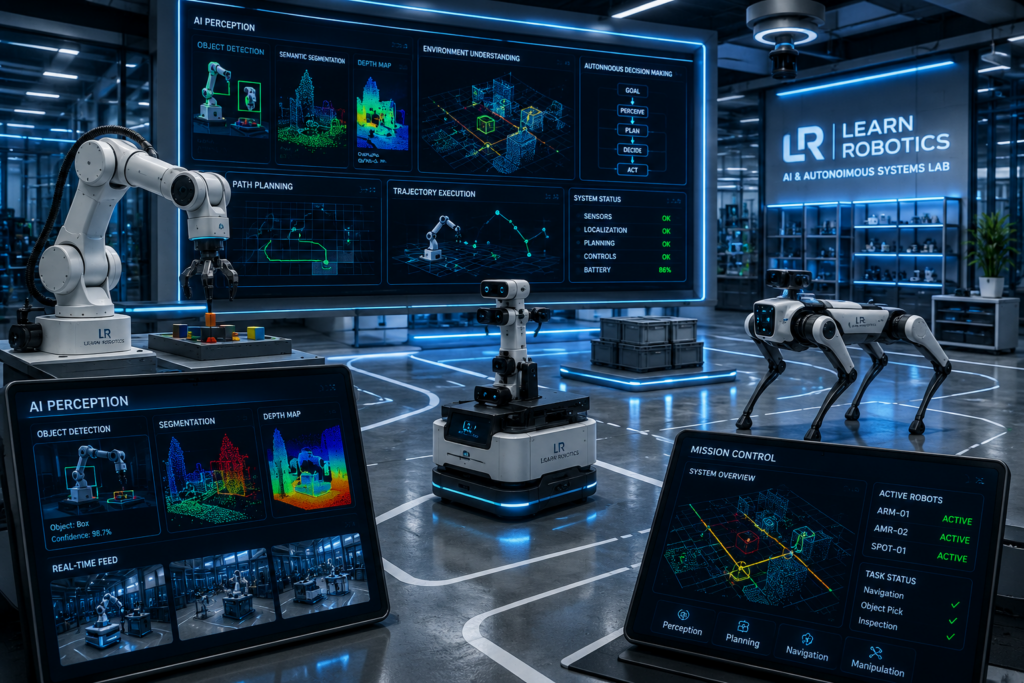
What if a robot could perceive the world, make decisions and learn how to act?
AI-powered robots combine physical machines with cameras, sensors and artificial intelligence to understand and interact with the real world.
Computer vision allows robots to recognize objects, estimate distances and interpret their surroundings in real time.
Autonomous systems can use this information to plan movements, avoid obstacles, navigate environments and decide how to complete a task.
Learn how artificial intelligence helps robots perceive their environment, make decisions, plan movements, and adapt to complex real-world situations.
AI & Autonomous Robotics requires three essential abilities:
PERCEPTION + PLANNING + ADAPTATION
Learning these skills is a first step toward Physical AI — intelligent systems that can perceive, reason and act in the physical world.
Could you help teach a robot to understand and complete a real-world task?
PRACTICAL MICRO-LESSON 01
SENSOR CONFIDENCE DECISION
MISSION 01 — DECIDE WHEN PERCEPTION IS RELIABLE
An autonomous robot must pick a component from a worktable.
Its vision system detects the component with 62% confidence.
The minimum confidence required for autonomous manipulation is 85%.
A second camera can provide another observation before the robot acts.
What should the robot do?
PRACTICAL MICRO-LESSON 02
AUTONOMOUS PATH PLANNING
MISSION 02 — SELECT THE SAFEST EFFICIENT ROUTE
An autonomous mobile robot must deliver a component to a workstation.
Its navigation system calculates three possible routes.
Route A: 14 meters — clear path — low collision risk.
Route B: 10 meters — moving workers and equipment — high collision risk.
Route C: 22 meters — clear path — low collision risk.
The robot must complete the delivery safely and efficiently.
Which route should the robot select?
PRACTICAL MICRO-LESSON 03
AUTONOMOUS RECOVERY
MISSION 03 — RECOVER FROM A FAILED ACTION
An autonomous robot attempts to pick an object.
The first grasp fails and the object remains on the table.
The robot still needs to complete the task, and another valid grasp position is available.
What should the autonomous system do next?
PRACTICAL MICRO-LESSON 04
GOAL PRIORITY DECISION
MISSION 04 — ADAPT WHEN PRIORITIES CHANGE
An autonomous robot is transporting a non-urgent component to Station A.
During the mission, the control system assigns a new high-priority task at Station B.
The robot is carrying the current component securely, and a safe drop-off point is available nearby where the task can be paused.
The high-priority task must be handled immediately.
What should the autonomous robot do?
PRACTICAL MICRO-LESSON 05
COMPLETE AUTONOMOUS MISSION
MISSION 05 — ADAPT, RECOVER AND COMPLETE THE TASK
An autonomous robot receives a mission to retrieve a component and deliver it to Station B.
The robot confirms the target, calculates a safe route and attempts the pickup.
The first grasp fails and the component remains on the table.
A second valid grasp position is available, but completing the mission now requires the robot to update its original plan.
What should the autonomous system do?