
Industrial Robotics
Industrial Robots — Automation & Teleoperation
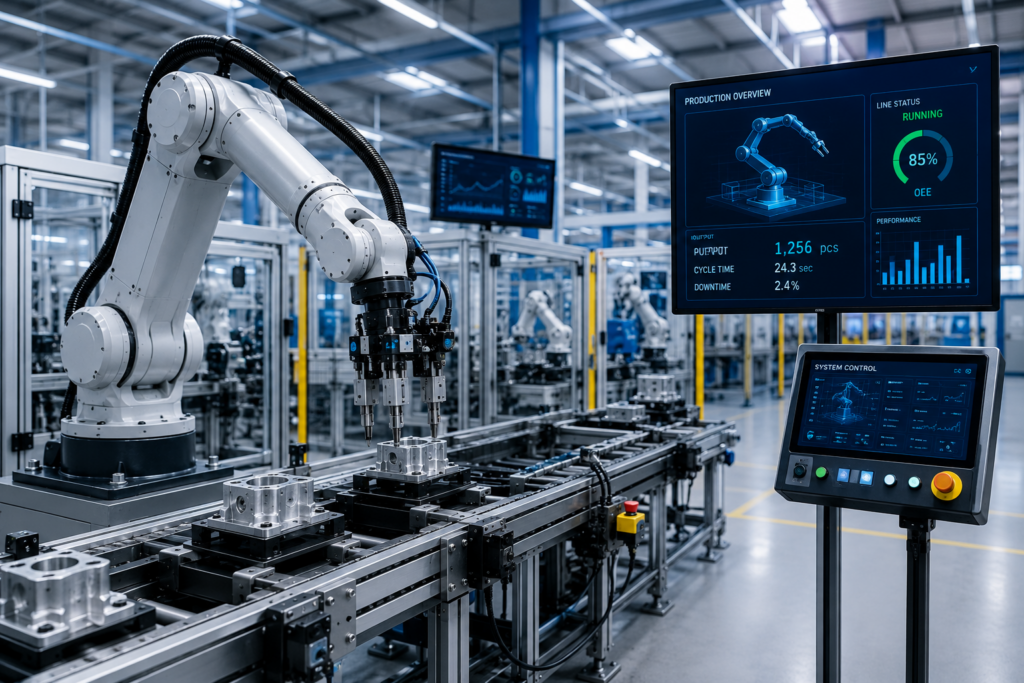
What if you could control a real industrial robot from anywhere in the world?
Industrial robots are already transforming manufacturing, logistics, inspection and automated production.
They can move components, manipulate tools, perform repetitive operations and execute tasks with speed and precision.
Teleoperation adds another capability: the operator does not necessarily need to be physically next to the robot.
A student, engineer or specialist could control a robotic system remotely while observing its movements through cameras and real-time data.
Industrial robotics requires three essential abilities:
PRECISION + CONTROL + DECISION MAKING
Learning these skills is the foundation for operating increasingly advanced robotic systems.
Could you control a real industrial robot?
PRACTICAL MICRO-LESSON 01
CONVEYOR PICK TIMING
MISSION 01 — SYNCHRONIZE THE ROBOT WITH THE CONVEYOR
A component is moving toward the pickup point on a conveyor.
The component will reach the pickup point in 3 seconds.
The robot needs 1 second to move its gripper into pickup position.
The robot and the component must arrive at the pickup point at the same time.
When should the robot start moving?
PRACTICAL MICRO-LESSON 02
PICK & PLACE SEQUENCE
MISSION 02 — EXECUTE THE CORRECT ROBOT CYCLE
A robot must move a component from a conveyor to an assembly tray.
The component must be securely gripped before the robot moves away from the pickup point.
The gripper must open only after the component reaches the target position.
Which sequence is correct?
PRACTICAL MICRO-LESSON 03
QUALITY CONTROL DECISION
MISSION 03 — HANDLE A DEFECTIVE COMPONENT
A vision sensor inspects components before the robot picks them from the conveyor.
A component has been detected with a quality defect.
Normal components must be placed in the assembly tray.
Defective components must be removed from the production flow.
What should the robot do?
PRACTICAL MICRO-LESSON 04
COLLISION & SAFETY RESPONSE
MISSION 04 — RESPOND TO AN UNEXPECTED OBSTACLE
The robot is moving a component toward an assembly station.
During the movement, a safety sensor detects an unexpected obstacle inside the robot’s planned path.
Continuing the current trajectory could cause a collision.
What should the robot do first?
PRACTICAL MICRO-LESSON 05
PRODUCTION CYCLE DECISION
MISSION 05 — COMPLETE THE PRODUCTION CYCLE
A robot is operating on an automated production line.
A component is approaching the pickup zone and has passed the vision inspection.
The component is approved for assembly, but a safety sensor detects an unexpected obstacle on the normal path to the assembly tray.
The robot must complete the task without risking a collision or sending the component to the wrong destination.
What is the correct sequence of actions?