
Logistics & Warehouse Robotics
Robots in Logistics — Picking, Sorting & Autonomous Movement
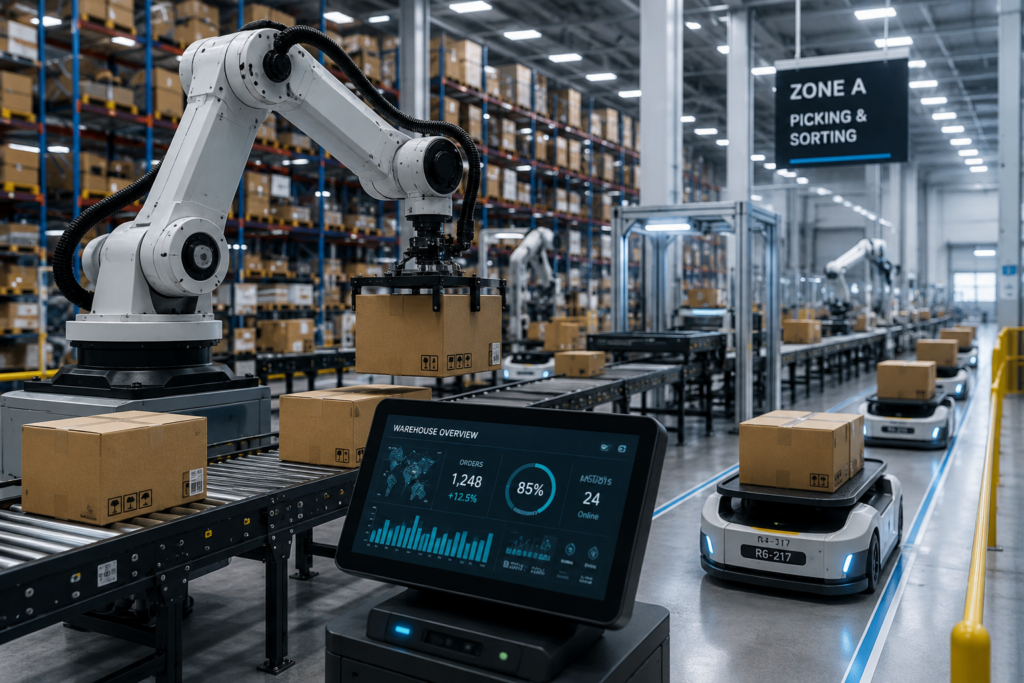
What if robots could move thousands of products with speed and precision?
Logistics robots are transforming warehouses, distribution centers and supply chains around the world.
Robotic systems can pick and place products, sort packages, move materials and transport goods autonomously through complex environments.
Cameras, sensors and AI allow robots to identify objects, calculate safe movements and react to changes in their surroundings.
Teleoperation adds another capability: a human operator can remotely control a robot when a task requires judgement, precision or intervention.
Logistics robotics requires three essential abilities:
PRECISION + COORDINATION + DECISION MAKING
Learning these skills is the foundation for controlling increasingly advanced warehouse and logistics robots.
Could you control a robot to pick, transport and place a package without making a mistake?
PRACTICAL MICRO-LESSON 01
PACKAGE ROUTING DECISION
MISSION 01 — SELECT THE CORRECT DESTINATION
A warehouse robot has picked a package from the sorting line.
The package barcode identifies its destination as ZONE B.
The warehouse has three available delivery zones: ZONE A, ZONE B and ZONE C.
The robot must deliver the package to the destination assigned by the warehouse system.
Where should the robot deliver the package?
PRACTICAL MICRO-LESSON 02
LOAD HANDLING DECISION
MISSION 02 — SELECT THE SAFE GRIP FORCE
A warehouse robot must pick a package from a storage shelf.
The package weighs 4 kg and requires at least 35 N of gripping force to be held securely.
The package can tolerate a maximum gripping force of 60 N without being damaged.
The robot can select one of three gripping forces.
Which gripping force should the robot use?
PRACTICAL MICRO-LESSON 03
DELIVERY PRIORITY DECISION
MISSION 03 — SELECT THE NEXT PACKAGE
A warehouse robot has three packages waiting for delivery.
Package 1 — standard order, deadline in 20 minutes.
Package 2 — priority order, deadline in 5 minutes.
Package 3 — standard order, deadline in 12 minutes.
The robot can transport only one package at a time.
Which package should the robot transport first?
PRACTICAL MICRO-LESSON 04
AUTONOMOUS PATH DECISION
MISSION 04 — RESPOND TO A BLOCKED ROUTE
A mobile warehouse robot is transporting a package to ZONE C.
Its planned route will reach the destination in 40 seconds.
A sensor detects another robot blocking the route ahead.
An alternative route is available and will reach ZONE C in 52 seconds without entering the blocked area.
The robot must complete the delivery safely without creating a traffic conflict.
What should the robot do?
PRACTICAL MICRO-LESSON 05
COMPLETE WAREHOUSE MISSION
MISSION 05 — COMPLETE THE DELIVERY CYCLE
A warehouse robot receives a priority package that must be delivered to ZONE B.
The package requires at least 35 N of gripping force and can tolerate a maximum of 60 N.
The normal route to ZONE B is blocked by another robot.
A safe alternative route is available.
The robot must complete the delivery safely and without damaging the package.
Which sequence of actions is correct?