
Medical Robotics
Robots in Medicine — Precision, Teleoperation & AI
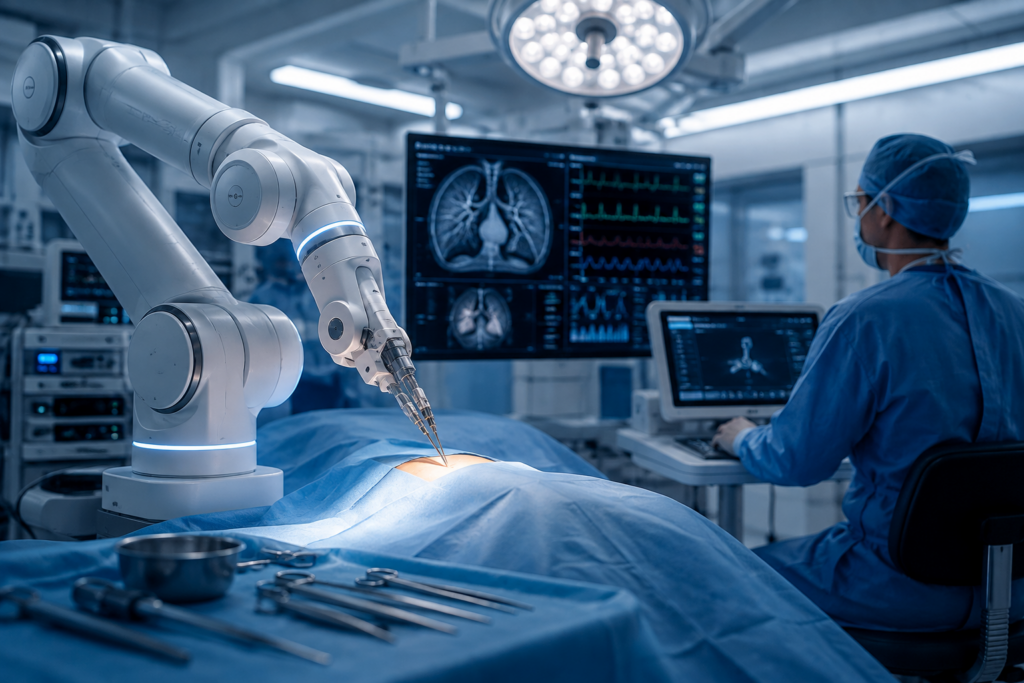
What if the world’s best skills could travel instantly?
Robots are already assisting doctors and researchers with tasks requiring extraordinary precision.
Robotic systems can help with surgery, laboratory work, rehabilitation, pharmacy automation and hospital logistics.
Teleoperation creates another possibility: the human and the robot don’t necessarily need to be in the same place.
Future medical robotic systems could allow specialized expertise to reach locations where that expertise isn’t physically available.
Medicine requires something robots find particularly difficult:
PRECISION + DEXTERITY + JUDGEMENT
That’s why learning to control a robotic arm accurately is so interesting.
Think your hands are steady enough?
PRACTICAL MICRO-LESSON 01
PRECISION & SAFE ROBOT MOVEMENT
MISSION 01 — APPROACH THE TARGET SAFELY
You are remotely controlling a robotic arm in a medical training environment.
The instrument tip is 35 mm above the target.
Your goal is to approach the target safely and stop 5 mm above it.
Which movement should you command?
PRACTICAL MICRO-LESSON 02
CONTROLLED APPROACH
MISSION 02 — CHOOSE THE SAFEST APPROACH
You are remotely controlling a robotic instrument toward a sensitive target.
The instrument tip is 40 mm above the target.
For safety, the final 10 mm must be performed at reduced speed.
Which movement sequence is safest?
PRACTICAL MICRO-LESSON 03
PRECISION ZONE CONTROL
MISSION 03 — ENTER THE PRECISION ZONE
You are approaching a sensitive medical target with a robotic instrument.
The instrument tip is 25 mm above the target.
The final 5 mm is a precision zone and must be entered at reduced speed.
Which movement sequence is safest?
PRACTICAL MICRO-LESSON 04
SAFE PATH CONTROL
MISSION 04 — AVOID THE RESTRICTED ZONE
You are remotely controlling a robotic instrument near a sensitive medical area.
A restricted zone is located directly below the instrument.
The robot must reach the target without entering the restricted zone.
Which movement sequence is safest?
PRACTICAL MICRO-LESSON 05
FINAL PRECISION APPROACH
MISSION 05 — COMPLETE THE SAFE APPROACH
You are performing the final approach to a sensitive medical target.
A restricted zone must be avoided during the movement.
The final 5 mm must be completed slowly for maximum precision.
Which movement sequence is safest?