
Robot Control Fundamentals
Understand Your Robot — Joints, Movement, Coordinates & Control
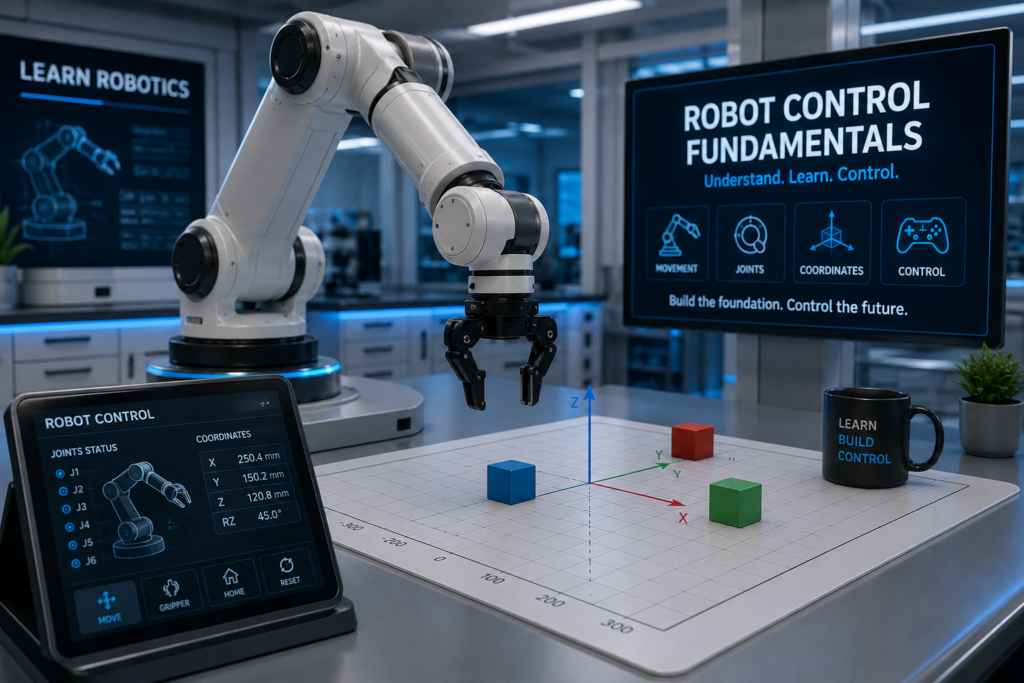
How does a robotic arm know where and how to move?
Every robot movement is created by combining the motion of multiple joints.
Robotic arms use joint rotations and coordinate directions to position the end-effector accurately in 3D space.
Understanding X, Y and Z movement, robot joints, gripper control and movement precision is the foundation of practical robot control.
These concepts apply across medical, industrial, agricultural, logistics and service robotics.
ROBOT CONTROL STARTS WITH THREE FUNDAMENTALS:
POSITION → ORIENTATION → PRECISION
In the following micro-lessons, you will make the same types of control decisions used when operating a robotic arm.
Ready to understand how a robot moves?
PRACTICAL MICRO-LESSON 01
ROBOT ARM ANATOMY
MISSION 01 — IDENTIFY THE ROBOT COMPONENTS
A robotic arm is built from several connected parts.
The joints allow the arm to rotate and change its configuration.
The links connect the joints.
At the end of the arm is the end-effector, which interacts with objects.
Which component directly interacts with the object during a pick-and-place task?
PRACTICAL MICRO-LESSON 02
JOINT CONTROL
MISSION 02 — UNDERSTAND JOINT MOVEMENT
A robotic arm has multiple joints that allow different parts of the arm to rotate.
Each joint can be controlled independently.
When a joint rotates, it changes the configuration of the robotic arm and can change the position or orientation of the end-effector.
Which command directly controls the rotation of an individual robot joint?
PRACTICAL MICRO-LESSON 03
CARTESIAN ROBOT CONTROL
MISSION 03 — CHOOSE THE CORRECT MOVEMENT AXIS
A robotic arm is positioned above a work surface.
The end-effector must move straight upward without intentionally changing its horizontal position.
In Cartesian control, the robot uses the X, Y and Z axes to move the end-effector through 3D space.
Which command should be used to move the end-effector upward?
PRACTICAL MICRO-LESSON 04
POSITION & ORIENTATION
MISSION 04 — CONTROL THE TOOL ORIENTATION
A robotic arm has already moved its end-effector to the correct position above an object.
The position is correct, but the gripper is rotated at the wrong angle and cannot grasp the object properly.
The robot must correct the gripper angle without intentionally changing its position.
What should the operator adjust?
PRACTICAL MICRO-LESSON 05
COMPLETE ROBOT CONTROL
MISSION 05 — COMPLETE A ROBOT MANIPULATION TASK
A robotic arm must pick up an object from a work surface.
The end-effector is not yet positioned above the object, and the gripper is not correctly oriented for the grasp.
The robot must position the end-effector, correct its orientation and securely grasp the object.
Which sequence correctly completes the task?