
Service & Humanoid Robotics
Humanoid Robots — Interaction, Teleoperation & Assistance
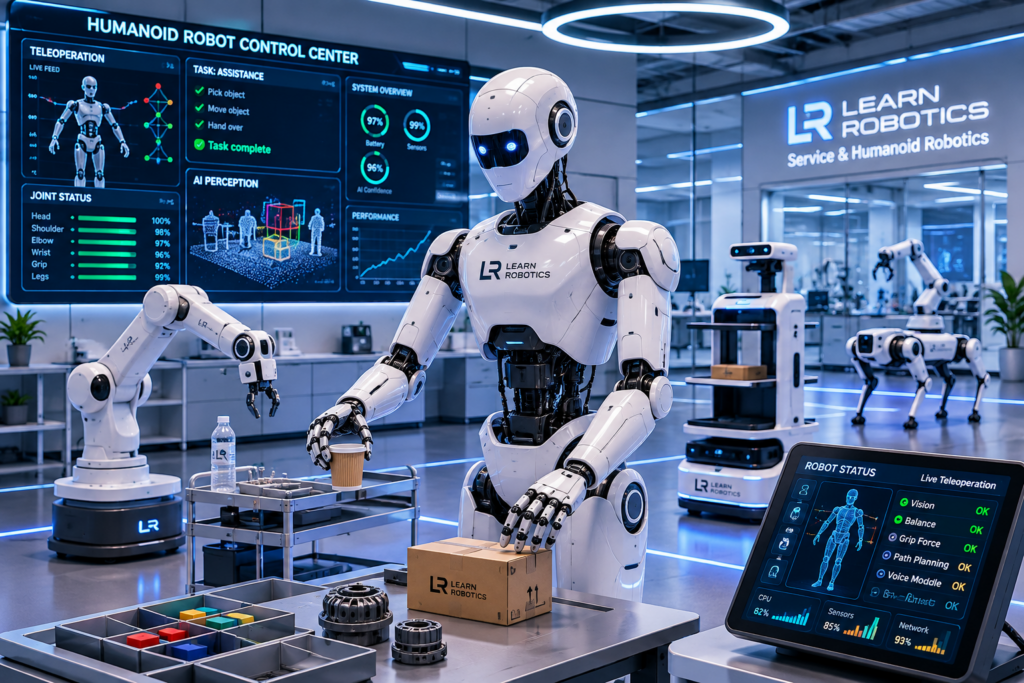
What if robots could work alongside humans and assist with everyday physical tasks?
Service and humanoid robots are being developed to operate in environments originally designed for people — from hotels and restaurants to hospitals, offices and homes.
These robots can manipulate objects, carry items, open doors, use tools and perform tasks that require coordination between perception and movement.
Cameras, sensors and AI help the robot understand its surroundings, recognize objects and determine how to interact with them safely.
Teleoperation adds an important capability: when autonomous systems encounter a task they cannot complete reliably, a human operator can remotely guide the robot and demonstrate the correct action.
Service & Humanoid Robotics requires three essential abilities:
PERCEPTION + DEXTERITY + HUMAN-ROBOT INTERACTION
Learning these skills helps us understand how robots can operate safely and effectively in environments shared with people.
Could you teach a humanoid robot to complete a task it has never performed before?
PRACTICAL MICRO-LESSON 01
HUMAN-AWARE MOVEMENT
MISSION 01 — APPROACH A SHARED WORKSPACE SAFELY
A humanoid service robot is carrying an object toward a worktable.
A person is standing near the table and partially inside the robot’s planned path.
The robot has enough space to reach the table using a wider route that keeps a safe distance from the person.
The task should be completed without unnecessarily interrupting the human.
What should the robot do?
PRACTICAL MICRO-LESSON 02
SAFE OBJECT HANDOVER
MISSION 02 — TRANSFER AN OBJECT TO A PERSON SAFELY
A humanoid service robot is holding a bottle and must hand it to a person.
The person reaches toward the bottle, but has not yet established a secure grip.
The robot must avoid dropping the object or applying unnecessary force during the handover.
What should the robot do?
PRACTICAL MICRO-LESSON 3
AMBIGUOUS INSTRUCTION DECISION
MISSION 03 — HANDLE AN UNCLEAR HUMAN COMMAND
A humanoid service robot is standing beside a table with two different boxes.
A person tells the robot:
“Bring me the box.”
Both boxes are within reach, but the person does not indicate which one they want.
Choosing the wrong box could result in an incorrect task.
What should the robot do?
PRACTICAL MICRO-LESSON 4
HUMAN SAFETY PRIORITY
MISSION 04 — RESPOND TO AN UNEXPECTED HUMAN MOVEMENT
A humanoid service robot is carrying a tray toward a table.
During the movement, a person suddenly steps into the robot’s path.
The robot detects the person at a safe stopping distance.
The delivery task is not urgent and can be resumed after the path becomes safe.
What should the robot do first?
PRACTICAL MICRO-LESSON 5
COMPLETE ASSISTANCE MISSION
MISSION 05 — COMPLETE A HUMAN-ROBOT TASK SAFELY
A person asks a humanoid robot to bring the blue bottle from a table.
The robot identifies the correct bottle and begins carrying it toward the person.
During the approach, another person unexpectedly steps into the robot’s path.
After the path becomes clear, the robot reaches the requester, who extends a hand to receive the bottle.
The robot must complete the task safely from movement to handover.
Which sequence of actions is correct?